Beyond the timeline, here's what each piece of the primary and secondary application is actually asking of you — and where people tend to lose points without realizing it.
Your Work & Activities section (W&A) is where you list the 15 most impactful experiences of your undergraduate years — plus any gap years you take before applying. Don't reach back to anything that ended before you started college; those experiences carry far less weight with admissions committees, since they want to see who you are now.
Common W&A entries include volunteering, teaching assistant work, clinical experience, research, jobs, and extracurriculars like music groups, clubs, or sports. The specific activity matters less than what it reveals: pick the roles that show the most longevity and personal development, and that say something true about who you are.
In 700 characters or fewer, you need to do two things at once: loosely outline your role, and describe how the activity shaped your growth and contributed to what makes you a strong applicant. The best entries quietly demonstrate one or more of the AAMC Premed Competencies — things like resilience, ethical responsibility, or scientific inquiry — without ever naming the competency outright.
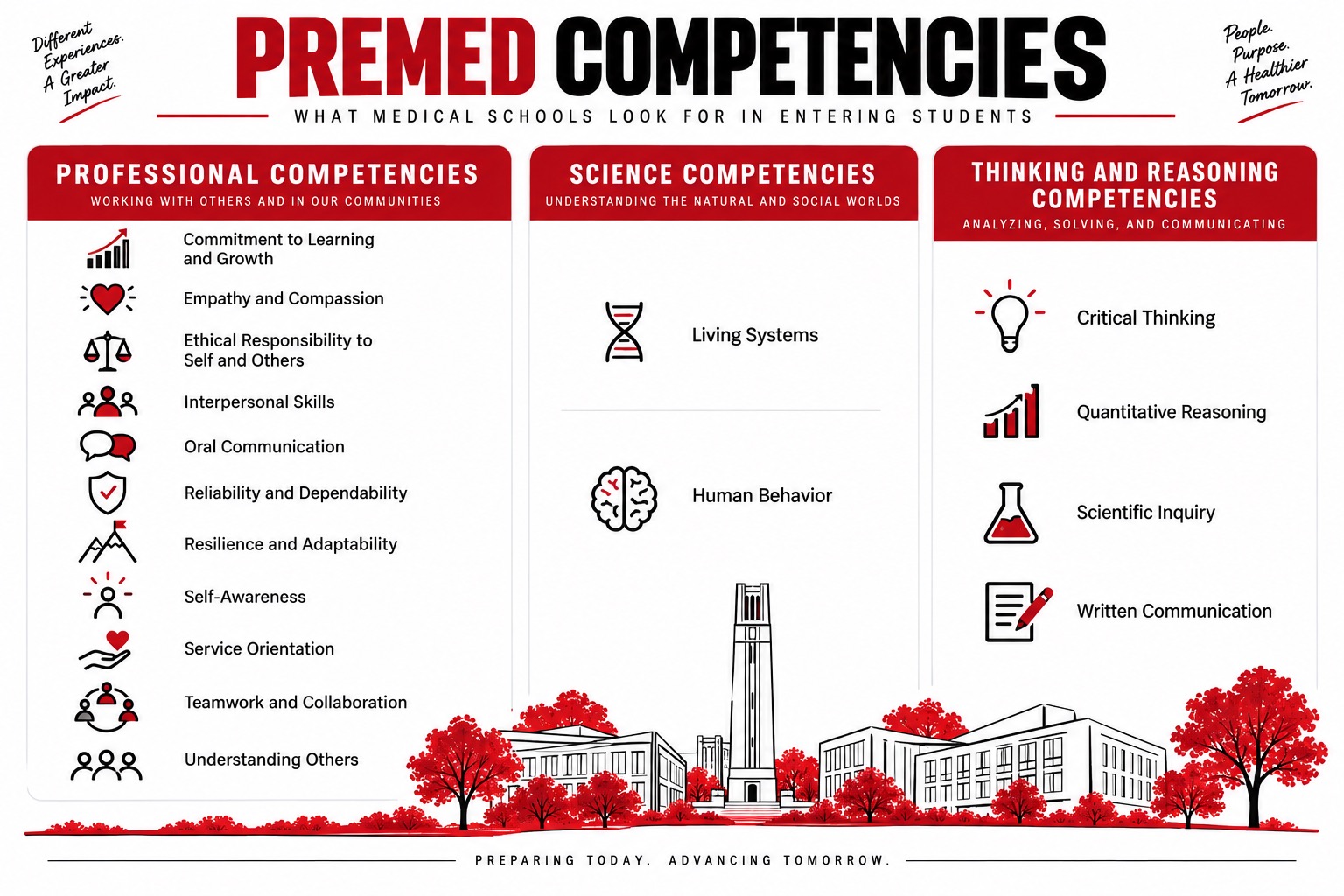
Of your 15 activities, you'll select 3 to expand into a Most Meaningful Experience (MME) — an extra 1,325 characters each. This is your chance to show, not tell, how the experience helped you build and demonstrate the competencies medical schools care about.
This is your story: who you are, what pulled you toward medicine, and why you'd be good at it. Common topics include a formative patient or family health experience, a research finding that changed how you think, a moment volunteering that reframed your sense of purpose, or a personal challenge that built the resilience medicine demands.
Your goal isn't to cover everything — it's to make sure the person reading your file remembers something specific about you after they've read fifty other essays that day. And just like your W&A entries, the strongest personal statements demonstrate the premed competencies through what you show happening, rather than naming them directly. Don't tell them you're resilient or empathetic — show them a moment where you had to be.
Submitting your primary application — Work & Activities, MMEs, Personal Comments Essay, and transcripts — as close to when AMCAS opens as possible gives you the best shot, since verification can take several weeks and schools review on a rolling basis.
Once your primary is submitted, the wait for secondaries begins — most schools start sending their first round to verified applicants about a month later, typically at the end of June or early July.
Turn secondaries around within 2 weeks of receiving them. It's not an official deadline, but it's the norm schools measure your interest and organization by. The only way to reliably hit it once several arrive at once is to pre-write — most schools reuse a small set of prompts year to year ("why us," diversity, adversity, teamwork), so draft your answers to the common ones before they land in your inbox.
Secondaries are also where your application gets genuinely creative. This is your chance to show a school what makes you specifically a fit for them — so research their program before you write a word. Reference specific opportunities they offer that you're excited about (name them), and connect part of their mission statement to your own beliefs about practicing medicine. Generic answers that could be copy-pasted into any school's secondary are the easiest ones for a reader to forget.
Writing is only part of it. Every application also needs a valid MCAT score (taken and scored within the last 3 years), transcripts from every undergraduate institution you've attended — including community colleges from dual enrollment in high school — and letters of recommendation.
Letters of recommendation give medical schools an outside perspective on your character, academic ability, work ethic, and readiness for medicine. Most schools accept or request 3–5 letters, though exact requirements vary — always check each school's admissions website or the MSAR before applying. AMCAS itself allows up to 10 letter entries, but that doesn't mean you should send all 10 to every school.
Two science professors who taught you, one non-science professor, and one or two additional writers who know you well through research, clinical work, employment, or service. There's no universal formula — individual schools set their own requirements — but who knows you well matters more than an impressive title.
Some schools offer a committee (or composite) letter through their pre-health advising office — an institutional evaluation that may incorporate individual faculty letters. Schools tend to value these for their broader, integrated view of you. If yours offers one, learn its internal deadlines and requirements early; it may involve its own application or interview. If your school doesn't offer one, that's completely fine — individual letters are the norm.
Tip: Ask recommenders well in advance, and ask directly whether they'd be comfortable writing you a strong letter. Give them your résumé/CV, your personal statement or application goals, and specific experiences you'd like them to highlight. Letters are submitted directly by the writer, not uploaded by you — and requirements vary by school, so always verify before applying.
Traditional interviews are conversational, one-on-one or panel. Multiple Mini Interviews (MMI) rotate you through several short scenario-based stations testing ethics, communication, and judgment. Ask each school which format to expect.
Decisions trickle out from October through the spring, with waitlist movement continuing into the summer. If you're waitlisted somewhere you'd attend, a concise letter of intent/interest can help — but follow each school's own policy on contact.
The MCAT page walks through the entire two-year runway from content review through matriculation.